Background:
MAPS (Monitoring Avian Productivity and Survivorship) is a continent-wide program that monitors bird population changes to conserve these birds and their habitats. As one of the longest running avian monitoring programs undertaken by the Lesser Slave Lake Bird Observatory; the LSLBO has contributed to the MAPS program since 1994 and operated four MAPS sites since 2003. Each of these four sites is visited six times over the breeding season (between May 31 to August 3) where six hours of songbird banding is undertaken to collect important data on the breeding bird populations in Lesser Slave Lake Provincial Park. By banding during the breeding season, population parameters such as productivity (how many young are produced) and survival (how many adults and juveniles are returning to breed) may be estimated. Conservation efforts can use our MAPS data to target potential causes of bird population declines, such as poor breeding success or poor wintering habitat quality.
2026 Season Summary:
MAPS operations were relatively uneventful this year with only a few net-hours lost due to poor weather or the likely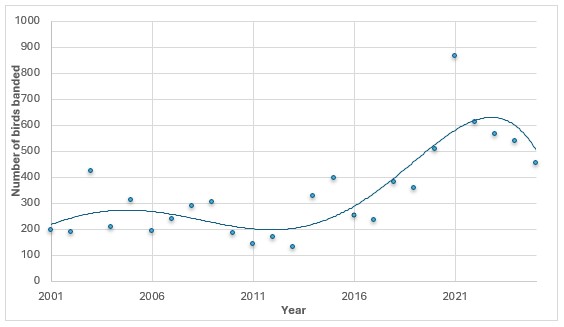 presence of predators. Unlike some of our recent busy years, no single day captured over 100 birds in a station and only three days caught over 50 birds in a station. MAPS capture rates are continuing to decline towards average after 2021’s record high (862 banded).
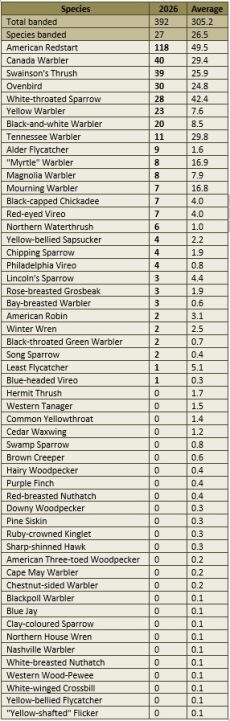
Preliminarily, the MAPS program banded 392 birds from 27 species, above the average of 305.2 birds from 26.5 species per MAPS season. This high average is in spite of shifting our MAPS program to begin 10 days earlier a few years ago. We now start our MAPS program in late May to adapt to a changing climate and to avoid the extremely high captures of migrants that we were experiencing when MAPS used to end in early August which overlapped with peak fall migration at the station.
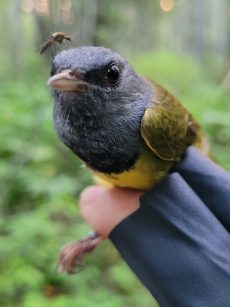
Mourning Warbler 2820-92865
No species saw record low band totals this year, but Alder Flycatcher tied their record-high of nine banded in 2024, Bay-breasted Warbler tied 2001 with three banded, and Northern Waterthrush broke their previous record of four banded in 2021 and 2022 with six banded in 2026.
A further 284 recaptures of birds previously banded this season was likewise above the MAPS average of 137 recaptures per MAPS season. Many of these recaptures were birds returning to breed locally from previous seasons, including male Mourning Warbler 2820-92865 who was first banded during MAPS 2020 in RESI, then recaptured only once each in 2021, 2024, and 2026 in the same station. He is now six years old.
Interested in experiencing our research programs? The LSLBO hosts guided drop-in tours every Wednesday and Saturday mornings until the end of August. Call the Boreal Centre for Bird Conservation at 780-849-8240 for more information.
For a full summary our 2026 MAPS banding season, see below: